
Rhythm and phrasing in improvisation
Anyone learning to improvise spends almost all their time on notes: scales, arpeggios, guide tones. And yet, if you hear a great soloist play just three notes, you know right away who it is. What makes a soloist recognizable isn't which notes they choose, but when they play them, how long they hold them and how much silence they leave around them.
Rhythm is the forgotten half of improvisation. This guide covers four concrete tools to work on it: swing, anticipations, space and motivic development. With examples to play and exercises you can start on right away.
Why rhythm matters more than notes
Try an experiment: take a phrase that's harmonically wrong but played with a confident, decisive rhythm, and a phrase with perfect notes played stiffly, all in even eighth notes, with no room to breathe. Almost every time, the listener prefers the first one.
The reason is simple: the ear picks up movement first and harmony second. An "outside" note played with conviction, on a strong rhythmic spot, sounds like a choice; a right note played hesitantly sounds like a mistake. So working on rhythm isn't a luxury for advanced players: it's the fastest way to make what you already know sound better.
Swing: eighth notes that aren't even
In jazz, written eighth notes aren't played evenly. At a medium tempo the first note of each pair is longer and the second shorter, in a ratio close to a triplet (2/3 + 1/3). That's swing.
But swing isn't just a formula of durations. Two details matter just as much:
- The accent on the offbeat. The offbeat eighth notes (the "and" in "1 and 2 and") are often slightly accented. That's what gives the forward push, like a "doo-BAH doo-BAH".
- The ratio changes with the tempo. At slow tempos the swing is more pronounced; at fast tempos the eighth notes get close to even, and the push comes from the accents.
The best way to learn swing is to sing it before you play it: sing a scale with the syllables "doo-bah doo-bah", accenting the "bah", over a swing groove. Then play exactly what you sang. Sheet music, including the examples below, writes even eighth notes by convention: the swing is up to you.
In bossa nova and rock, on the other hand, eighth notes stay straight (even): knowing when to swing and when not to is part of phrasing.
Anticipations: arriving ahead of the beat
An anticipation (or "push") is a note that, instead of landing on the downbeat, arrives half a beat early and is tied into the next bar. It's one of the most characteristic effects in jazz: it makes the melody feel like it's "pushing" the rhythm section.
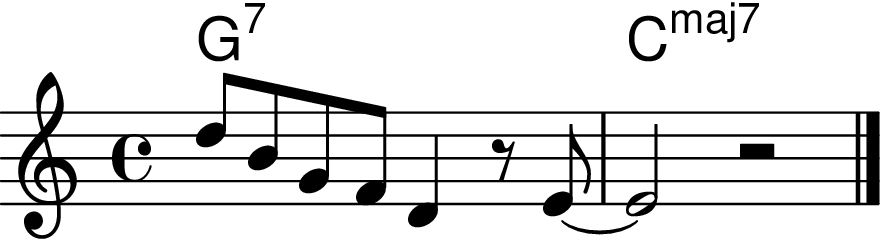
In the example, the target note, E (the 3rd of Cmaj7), doesn't wait for beat one of the new bar: it starts on the last eighth note of the G7 bar and is tied over. Try playing the phrase two ways, first with the E on beat one and then anticipated: the second version instantly sounds more like jazz, even though the notes are identical.
Anticipations work best on target notes, the guide tones that resolve a chord change. Anticipating everything, though, makes you lose the sense of time: use them like a spice.
Space: rests are part of the phrase
The most common mistake improvisers make is playing too much. When the groove is rolling and your fingers know the scale, the temptation is to fill every available eighth note. The result is a continuous stream with no punctuation, and the ear soon stops following it.
Think of phrasing like speech: nobody talks without breathing. Rests:
- separate ideas, making it clear where one phrase ends and the next begins;
- give weight to what you play next;
- let the band play, responding in the meantime and building tension.
An exercise that seems trivial but changes everything: improvise for a whole chorus playing only in the odd-numbered bars and leaving the even ones empty. Then only one bar out of three. You'll find your phrases become more thought-out and the silence, instead of being a gap, creates anticipation.
Another one: limit your phrases to two bars at most, followed by at least one bar of rest. It's the same principle as the call and response we looked at in the guide on how to improvise over the blues.
Motifs: developing one idea instead of inventing a hundred
A motif is a small cell — three or four notes with a specific rhythm — that becomes the common thread of a section of your solo. Instead of looking for a new idea in every bar, you take one and develop it. The listener recognizes the cell and follows its transformations like a story.

In the example, over a I-VI-II-V progression in C, the motif E–G–A is:
- stated over Cmaj7, with a rest before and after;
- anticipated by an eighth note and extended over A7, adding C# (the chord's 3rd);
- transposed over Dm7 (F–A–C), with the same rhythm as the opening;
- closed over G7 with a different ending that lands on B (the 3rd).
Four bars, one idea, and a clear path. The most useful transformations to apply to a motif:
- repetition (identical, to fix it in the listener's ear);
- transposition (same shape on another degree, adapted to the chord);
- rhythmic displacement (same cell, on a different spot in the bar);
- augmentation and diminution (longer or shorter notes);
- fragmentation (just the first two notes, repeated);
- inversion (the shape that went up now goes down).
It's the same work you do with licks, as explained in how to learn licks without parroting them: a lick is, after all, just a longer motif.
A 15-minute rhythm routine
Add this to your practice, over a backing track:
- 3 minutes — one note only. Improvise using a single note (the root, for example). All the work is rhythmic: durations, accents, rests, anticipations. It feels limiting, but it's the best phrasing exercise there is.
- 4 minutes — two bars on, two bars off. Two-bar phrases alternating with two bars of silence.
- 4 minutes — one motif. Pick three notes, and for a whole chorus play only transformations of that cell.
- 4 minutes — free with anticipations. Improvise freely, deliberately anticipating every arrival on a chord change.
Try it with Ziricote
The only way to learn rhythm is by playing over something that keeps time. With Ziricote:
- Open the Licks section and choose Jazz Swing: the backing track gives you the swing pulse of bass, drums and comping. Switch to Backing only to have the rhythm section all to yourself.
- Do the 15-minute routine starting from a comfortable Tempo; swing comes across best at medium tempos, around 120 bpm.
- Switch styles to hear the difference: try the same exercise over Bossa Nova (straight eighth notes) and then go back to swing.
- Listen to the licks in the app paying attention to rhythm: where they start, where they stop, where they anticipate. Then play them displaced by an eighth note, as in the motif example.
- Change the Key once the motif exercise gets easy: transposing a cell to another key is the natural next step.
You can also browse the swing licks on the website. Ziricote is available on the App Store and Google Play: you'll find the links below.
Frequently asked questions
What is phrasing in improvisation? It's how you organize notes in time: where you start and end a phrase, how long you make it, where you put accents, anticipations and rests. Two musicians playing the same notes with different phrasing produce completely different solos.
How do you play swing? Eighth notes are played unevenly, with the first note of each pair longer and the second shorter (in a ratio close to a triplet), with a slight accent on the offbeats. The most effective way to learn it is to sing phrases with syllables like "doo-bah" over a swing groove and then play them the same way.
What is an anticipation in jazz? It's a note that arrives half a beat before the downbeat and is tied into the next bar. It's used mostly on the target notes of chord changes and gives the phrase the forward push typical of jazz.
Why leave rests when improvising? Because rests separate ideas, give weight to the phrases that follow and leave room for the rhythm section. A solo without rests becomes a continuous stream that's hard to follow; one with well-placed rests sounds like a conversation.
What is motivic development? It's the technique of building part of a solo around a small melodic and rhythmic cell, repeating it, transposing it, shifting it in time or breaking it into fragments. It gives the solo coherence and lets the listener follow where it's going.
Want to practice swing, anticipations and motifs over a real rhythm section? Download Ziricote: backing tracks in lots of styles, at any tempo and in any key.