
Improvising over the 12-bar blues
The 12-bar blues is the first progression almost everyone tries to improvise over, and for very good reasons: it's short, it repeats the same way every time, it uses only a few chords, and it's the common root of jazz, rock, soul and funk. But precisely because it looks simple, many players stay stuck for years on the same scale, running it up and down without the solo ever really saying anything.
This guide takes you further: understanding the form, using the blues scale and Mixolydian, following the chords with seventh-chord arpeggios and building phrases with call & response, the question-and-answer that sits at the heart of the blues language.
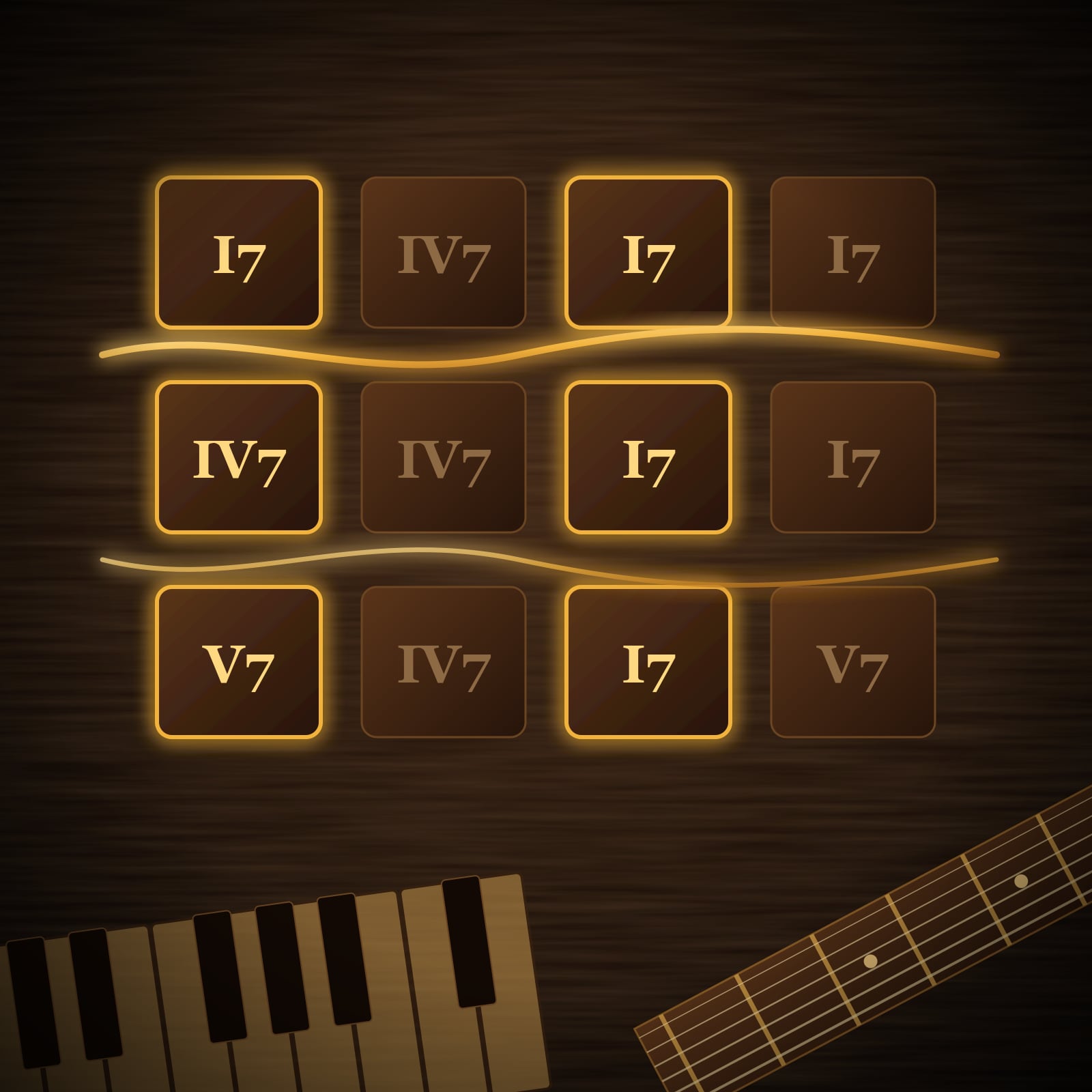
The form: 12 bars, three phrases
The basic blues uses three dominant seventh chords, built on the I, IV and V degrees. In A they are A7, D7 and E7:
| Bars | 1 | 2 | 3 | 4 |
|---|---|---|---|---|
| 1-4 | A7 | D7 | A7 | A7 |
| 5-8 | D7 | D7 | A7 | A7 |
| 9-12 | E7 | D7 | A7 | E7 |
The D7 in bar 2 is the so-called quick change: some players stay on A7 there, but it's worth hearing it because it gives you an early taste of the IV chord's color. The E7 in the last bar is the turnaround, which sends you back to the top of the form.
It helps to think of the blues as three four-bar phrases, almost like a rhymed verse: the first states an idea, the second repeats it over the IV (with a different color), the third resolves it. This AAB structure comes from the vocal blues tradition, and it's a valuable guide for improvisers too: a solo that follows the three phrases immediately sounds "inside" the form.
In jazz the same form gets dressed up with ii-Vs. A typical jazz blues in F is:
| Bars | 1 | 2 | 3 | 4 |
|---|---|---|---|---|
| 1-4 | F7 | Bb7 | F7 | Cm7 – F7 |
| 5-8 | Bb7 | Bdim7 | F7 | D7 |
| 9-12 | Gm7 | C7 | F7 – D7 | Gm7 – C7 |
The extra chords (Cm7–F7 leading to the IV, Gm7–C7 leading to the I) are the same ii-V-Is you find in the standards. Start with the basic blues; add these changes once the three phrases come naturally.
The blues scale: the sound, not the map
The A blues scale is the minor pentatonic with one extra note, the blue note (the ♭5):
A – C – D – E♭ – E – G
The beauty of this scale is that it works over all three chords: you can play it from the top of the form to the end without hitting a "wrong" note. Its limit is the same thing: used on its own, every bar sounds the same, because the scale ignores the chord changes.
Two tweaks make it instantly more expressive:
- The C over A7 is a tension, not a resting note. Over a major chord (A7 contains C#), the minor 3rd creates that typical blues rub. The masters' trick is not to sit on it: pull it up toward the C# with a bend, a slide or a chromatic C–C# move.
- The blue note is a passing tone. The E♭ lives for an instant, between D and E. Hold a long note on it over A7 and it sounds "wrong"; pass through it and it sounds like the blues.
Mixolydian: following the chords
Every chord in the blues is a dominant seventh, and the "natural" scale for a dominant chord is Mixolydian (the major scale with a lowered 7th). In the A blues:
- over A7 → A Mixolydian: A B C# D E F# G
- over D7 → D Mixolydian: D E F# G A B C
- over E7 → E Mixolydian: E F# G# A B C# D
Notice the difference between A7 and D7: over A7 there's C#, over D7 there's C natural (its 7th). That's exactly the note that makes the chord change audible. If you switch from the blues scale to Mixolydian on the changes, and go back to the blues scale when you want some grit, you have two colors to play with instead of one.
The classic blues sound comes precisely from mixing the two worlds: minor 3rd and major 3rd in the same phrase, with the minor 7th always there. It's not a theory mistake: it's the language. If you want to dig deeper into how to pick a scale for each chord, it's all in the guide Which scales to play over chords.
Seventh-chord arpeggios: the backbone
Scales give you the possible notes; arpeggios give you the safe ones. The chords of the A blues are:
- A7: A – C# – E – G
- D7: D – F# – A – C
- E7: E – G# – B – D
The most important notes are the 3rd and 7th of each chord, the guide tones. In the blues there's a beautiful connection between A7 and D7: the C# (3rd of A7) drops a half step to C (7th of D7), and the G (7th of A7) drops a half step to F# (3rd of D7). Going back to A7, the path reverses. Two half steps that, on their own, trace the whole harmonic movement.

In the example the A7 arpeggio goes up and comes down to C#; over D7 the same note drops to C (the 7th), the line touches F# and climbs back chromatically until it finds C# again over A7. Play it slowly and listen to how changing a single note is enough to tell the story of the chord change.
Call & response: building phrases that speak
Call & response comes from work songs and gospel: one voice calls, another answers. In a solo it becomes a very simple way to give shape to your ideas: you play a short phrase (the call), leave some space, then answer with a variation.

In the example the call (bars 1-2) descends and lands on the root, A. The response (bars 3-4) starts identically, so the ear recognizes it, but changes the ending: it climbs through the blue note up to E and then falls back. Same idea, different conclusion: that's how a phrase turns into a conversation.
Practical rules for call & response:
- Short phrases. One or two bars are plenty for the call. Long phrases leave no room for the answer.
- The rest is part of the phrase. The silence after the call is the moment the listener "waits" for the answer. Don't fill it.
- Change just one thing. The response picks up the rhythm or notes of the call and varies a single element: the ending, the register, one note.
- Follow the three phrases of the blues. Call in bars 1-2, response in bars 3-4; then the same over the IV (5-8), and a closing phrase over the turnaround (9-12).
Putting it all together: a plan for your solo
An effective way to organize a solo over several choruses is to add one element at a time:
- First chorus: blues scale and call & response only. Few notes, short phrases, lots of space.
- Second chorus: Mixolydian on the changes. Make the C# heard over A7 and the C over D7; everything else can stay bluesy.
- Third chorus: guide tones. Land on every chord change with the 3rd or the 7th, as in example 2.
- Fourth chorus: free. Mix the three colors and let your ear choose.
The most common mistakes? Playing the whole scale top to bottom like an exercise, never leaving space, and ignoring the turnaround (bars 11-12 are the springboard into the next chorus: set them up with a phrase that leads to E7).
Try it with Ziricote
Theory only sticks when you play it over a real rhythm section. In Ziricote you can do it like this:
- Open the Licks section and choose the Blues Shuffle style: the 12-bar blues backing track in A starts, with bass, drums and comping.
- Turn the lick off (Backing only) and improvise the four choruses of the plan above, one at a time.
- Use the Tempo control to start slow — even 70 bpm — and only speed up when your phrases come out clean.
- Change the Key: the backing track and the licks move together into any of the 12 keys. The blues in E, G and B♭ is just as common, and redoing the exercise elsewhere is the best way to stop thinking in "shapes" and start hearing functions.
- Study the app's blues licks (you'll also find them on the website), slowed down if you like, and use them as calls to answer with your own phrases.
Ziricote is available on the App Store and Google Play: you'll find the links below.
Frequently asked questions
What scale do you use to improvise over the blues? The most common is the blues scale (minor pentatonic with the ♭5), which works over the whole form. To follow the chords you add the Mixolydian scale of each chord: A Mixolydian over A7, D Mixolydian over D7, E Mixolydian over E7. The typical sound comes from mixing the two.
What are the chords of the 12-bar blues? In the basic form they are three dominant seventh chords on the I, IV and V degrees: in A, A7, D7 and E7, laid out over 12 bars (I-IV-I-I, IV-IV-I-I, V-IV-I-V). In jazz, ii-Vs and passing chords are added.
What is the blue note? It's the diminished fifth (♭5) added to the minor pentatonic, which turns it into the blues scale. In A it's E♭. It's used mainly as a passing tone between the 4th and the 5th, not as a long note.
What is call & response in improvisation? It's the question-and-answer technique: you play a short phrase, leave space, then answer with a variation of the same idea (same beginning, different ending). It gives shape and coherence to the solo and is at the core of the blues language.
Which notes should you play on the blues chord changes? The guide tones: the 3rd and 7th of each chord. In the A blues, C# (3rd of A7) drops to C (7th of D7) and G (7th of A7) drops to F# (3rd of D7): targeting these notes makes the chord change audible even without accompaniment.
Want to improvise over the blues every day, in any key? Download Ziricote: the Blues Shuffle backing track, licks to study even slowed down, and key changes with a single tap.