
How to Learn Licks Without Parroting Them
Every improviser learned from other people's phrases. Licks — short, ready-made phrases typical of a style — are the fastest way to absorb the language of jazz, blues or bossa nova: they put "right" sounds under your fingers that would take you months to find on your own.
The problem comes later. Many players pile up dozens of licks and then, in the solo, paste them one after another, always identical, always in the same spot of the progression. The result sounds mechanical: that's parroting. This guide explains how to turn a lick from a memorized phrase into a musical idea of your own, one you can move, vary and fit to any tune.
Why licks sound "copied"
A lick sounds fake for three reasons, almost always together:
- It's tied to a single key. You know it in C, and as soon as the tune moves to E♭ you no longer know where to put it, so you avoid it or force it.
- It's tied to a single rhythm. It always starts on beat one, with the same note lengths. The listener's ear recognizes it as a block.
- You don't know why it works. If you don't know which notes of the lick make the chord audible, you can't change it without breaking it.
Each of these limits has a specific exercise. We'll work on a single lick, original and deliberately simple, over a ii-V-I in C major.
Step 1: understand why it works
Before repeating a lick a hundred times, analyze it. You don't need a treatise: just find the notes that matter.
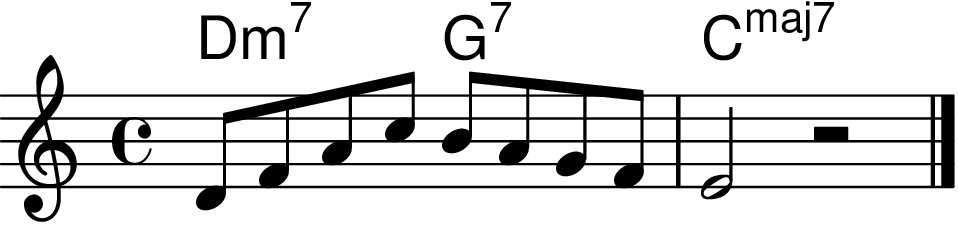
In our example:
- over Dm7 the lick is the chord arpeggio: D, F (3rd), A, C (7th);
- the C (7th of Dm7) moves down a half step to B, the 3rd of G7, right on the chord change;
- over G7 the line descends to F (7th of G7);
- the F moves down a half step to E, the 3rd of Cmaj7, on the resolution.
In other words, the lick is built around guide tones: a 7th falling to a 3rd, twice in a row. Everything else is "filler". This discovery changes everything: as long as you respect those two landing points (B over G7, E over Cmaj7), you can change almost everything else and the lick will still work.
Exercise: for every lick you learn, write next to each chord the note that lands on the change and which degree it is (3rd, 7th, 9th…). If a lick has no clear landing points, it's a weaker lick: learn the ones that do first.
Step 2: take it through all 12 keys
A lick you know in one key is a piece of information. The same lick in 12 keys is vocabulary. Transposing forces you to think in degrees ("I start from the root of the ii, I land on the 3rd of the V"), not in finger positions.
The same lick in F major (Gm7 – C7 – Fmaj7) becomes:
| Chord | Notes |
|---|---|
| Gm7 | G – B♭ – D – F |
| C7 | E – D – C – B♭ |
| Fmaj7 | A |
The shape is identical: arpeggio of the ii, the 7th (F) falling to the 3rd of the V (E), the 7th of the V (B♭) falling to the 3rd of the I (A).
How to go about it without getting bored:
- Follow the circle of fifths: C, F, B♭, E♭, A♭… That's the order in which ii-Vs actually follow one another in standards.
- Sing it before you play it. If you can sing the lick in the new key, your fingers will find it. If you can't, you're just moving a shape.
- You don't have to do them all today. Three keys a day for a week are worth more than twelve rushed through.
- On keyboard and guitar, change position. On guitar the same lick can be played in at least three areas of the neck: learning them all keeps you from getting trapped in a single "box".
Step 3: change its rhythm
Rhythm is what makes a lick recognizable (and therefore "copied"), much more than the notes. Changing the rhythm while keeping the notes is the fastest way to make it sound new.
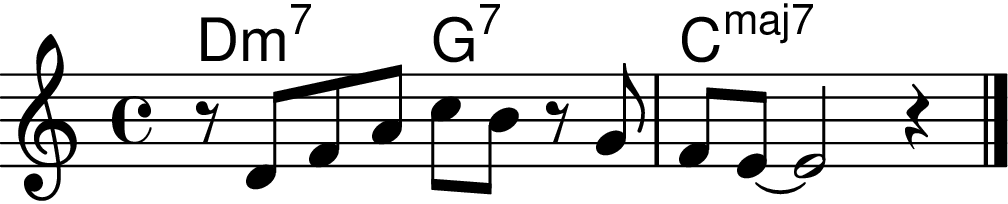
Here the notes are almost the same as in example 1, but:
- the lick starts an eighth note later, on the offbeat: that alone makes it sound more "spoken";
- the C now falls on beat one of G7: it becomes a held note (a suspension) that resolves to B;
- there's a rest in the middle of the bar, splitting the phrase into two breaths;
- the final E arrives early and is tied over, instead of landing on the downbeat.
Other rhythmic transformations to try on any lick:
- Displace it: start it on each of the 8 eighth notes of the bar.
- Stretch or compress it: play in quarter notes what was in eighths (or vice versa), maybe just for half of the lick.
- Remove notes: play only every other note, or only the notes on the beat. The "stripped-down" version is often the most beautiful.
- Repeat a fragment: take the first three notes and repeat them before completing the phrase.
We covered these tools in depth in the guide on rhythm and phrasing in improvisation.
Step 4: take it apart and put it back together
You don't have to play a lick in full. Split it into cells — beginning, middle, ending — and treat them as interchangeable parts:
- use only the ending (F–E) as the resolution of one of your own phrases;
- use only the beginning (the arpeggio of the ii) and then continue with an idea of your own;
- connect the beginning of one lick with the end of another, as long as the meeting point is a guide tone.
This is where the lick stops being a quotation and becomes building material. Great improvisers rarely play a whole lick the same way twice: they play fragments, combined differently every time.
Step 5: use it in a real context
Finally, the lick has to go inside a tune, not just be practiced over an isolated ii-V. Three questions to ask yourself:
- Where does this progression appear in the tune? Every major ii-V-I is a possible spot, in any key.
- What do I play before and after? Set up the lick with a short phrase and leave space afterwards: that way it sounds like it was born there.
- I use it only once. Repeating the same lick on every ii-V is the exact opposite of improvising. Once per solo, varied if anything.
Try it with Ziricote
Ziricote has a section designed exactly for this method:
- Open the Licks section and choose a style, for example Jazz Swing or Bebop. Every lick is original, written in standard notation and tab, with its own backing track.
- Listen to it and learn it slowed down: lower the Tempo until you play it cleanly, then bring it back up to the original tempo. If a passage is hard, select it and play it on a loop.
- Step 1: look at the chords above the lick and find the guide tones it lands on.
- Step 2: change the Key: the backing track and the lick move together into any of the 12 keys. Go around the circle of fifths, three keys a day.
- Steps 3 and 4: switch to Backing only and play the lick over the backing track, changing its rhythm, removing notes, using only the beginning or only the ending.
You can also browse the licks on the website before opening the app. Ziricote is available on the App Store and Google Play: you'll find the links below.
Frequently asked questions
Is it wrong to learn licks by heart? No: learning other people's phrases is how everyone has learned the language. The problem is always using them the same way. A lick has to be understood (which guide tones it hits), transposed into every key and varied rhythmically, until it becomes an idea of your own.
How do you transpose a lick into all keys? You analyze it in degrees (which note falls on which degree of the chord) and reproduce the same pattern starting from another key, usually following the circle of fifths. Singing it before playing it helps you avoid just moving a shape around the neck or the keyboard.
How many licks do you need to know to improvise? Fewer than you think. A few licks known inside out — in 12 keys, with rhythmic variations and broken down into fragments — are worth more than a hundred licks memorized in a single key.
How do you avoid always playing the same licks? By changing their rhythm (displacing them onto the offbeat, adding rests, compressing or stretching them), using only a fragment, combining the beginning of one with the end of another and limiting yourself to using each one at most once per solo.
What are the guide tones in a lick? They're the 3rds and 7ths of the chords that the lick lands on at the changes. In a good lick over a ii-V-I, the 7th of each chord falls a half step to the 3rd of the next: those landing points are what make it sound "inside" the harmony.
Want to make licks your own instead of repeating them? Download Ziricote: original licks with backing tracks, which you can slow down, loop and transpose into all 12 keys.