
Jazz Waltz: How to Improvise Swing in 3/4 Without Getting Lost
To improvise over a jazz waltz, you have to stop counting in four: swing in 3/4 feels best in two-bar groups, meaning six beats with the strong accent on beat 1 of the first bar. Your phrases work when they start and land on clear points in that cycle, run shorter than the ones you'd play in 4/4, and lean on the guide tones (3rd and 7th) of each chord. The rest is rhythmic work: accents, space and hemiola.
If you're comfortable in 4/4 but find yourself halfway through a chorus on a jazz waltz with no idea where you are, it's not a scale problem. It's a rhythmic ear problem: your body is used to phrases that close every four beats, and in 3/4 those phrases slide past the barline. In this guide we'll rebuild your sense of time, look at the harmony you can expect, and set up concrete ways to practice.
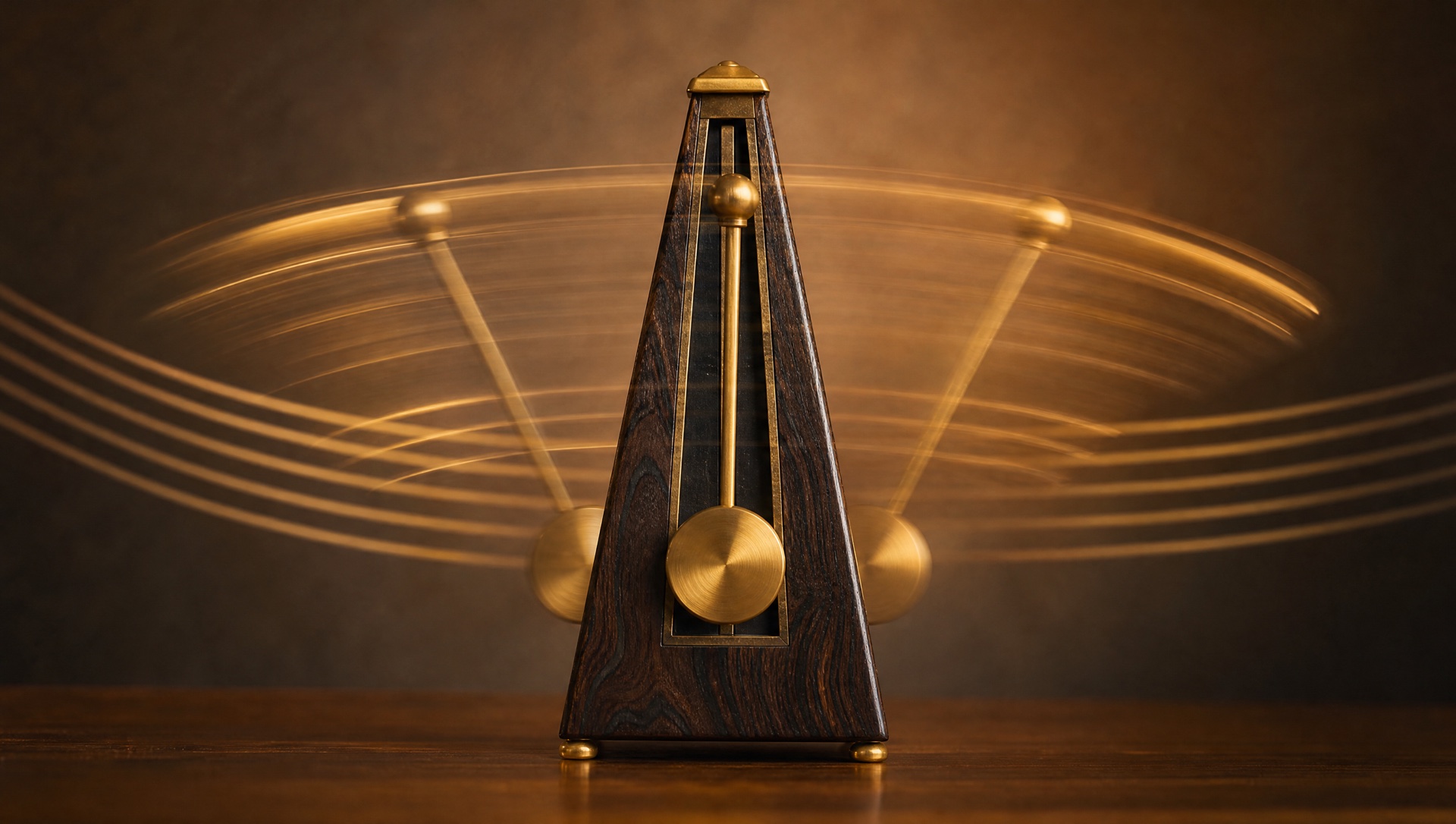
What a jazz waltz is and why it sounds different from a classical waltz
A classical waltz is "OOM-pah-pah": bass on 1, chords on 2 and 3, straight eighth notes, a steady rocking motion. A jazz waltz keeps the same 3/4 meter but plays it with swing: the eighths are triplet-based, the drummer's ride pattern often falls on 1, 2 and the "and" of 2 (or of 3), and the pianist comps irregularly instead of hammering beats 2 and 3. The bassist might walk in three or play a dotted half note on 1 with a few passing tones.
The result is a groove that turns in circles rather than walking in a straight line. Many players hear a jazz waltz as one long 6/4, two bars fused into a single wide pulse, and that's exactly the key to not getting lost.
| Aspect | Swing in 4/4 | Swing in 3/4 |
|---|---|---|
| Beats per bar | 4 | 3 |
| Eighth notes per bar | 8 | 6 |
| Natural phrase unit | 1-2 bars | 2-4 bars (6-12 beats) |
| Typical rhythmic accents | 2 and 4 | Strong 1, lighter 2 and 3 |
| Main risk | Playing too straight | Ending phrases in the wrong place |
Feeling 3/4: accents, hemiola and the six-beat cycle
Before you play a single scale note, you need 3/4 in your body. Three mental tools will help.
Accents. Beat 1 is your anchor. Tap your foot only on 1 of each bar and let 2 and 3 float. Then try the opposite: foot on 2 and 3, silence on 1. If you can feel 1 even when you're not marking it, you've already done half the job.
The six-beat cycle. Count two bars as one: "ONE-two-three-TWO-two-three." The big accent comes every six beats. A two-bar phrase becomes a compact unit, the equivalent of one bar of 4/4 to your ear, and it becomes much easier to know where you are in the form.
Hemiola. This is the effect where two bars of 3/4 are split into three groups of two beats: "1-2 | 3-1 | 2-3." The six beats stay the same, but the accent moves, and for a moment it feels like 2/4. Great soloists use hemiola to build tension and then "come home" on beat 1. A practical example: over Cmaj7, play quarter notes accenting every second note, G-E-G-E-G-E, stressing the first, third and fifth notes. Hear how the time seems to shift and then realigns at the start of the next pair of bars.
Two- and four-bar phrases: how to keep your place
In 4/4, a phrase of eight eighth notes fills one bar. In 3/4 that same phrase lasts a bar and a third, ending on beat 2 of the next bar. If you're not aware of it, your next phrase will start in the wrong spot, and a few bars later you're lost.
The fix is to build phrases by length, not by number of notes:
- Two-bar phrases (6 beats): start on 1 or the "and" of 1, end on beat 3 of the second bar or on beat 1 of the third.
- Four-bar phrases (12 beats): two six-beat blocks, the first as a question and the second as an answer.
- Breathe: leave at least one bar of rest after each phrase. In 3/4 an empty bar goes by quickly, so don't be afraid of it.
A very effective trick is to decide your landing point in advance: "this phrase ends on beat 1 of bar 5." Everything else organizes itself backwards from there. For more on space, anticipations and motifs, see rhythm and phrasing in improvisation.
Typical jazz waltz harmony and guide tones
Jazz waltzes use the same harmony as 4/4 standards: major and minor ii-V-Is, secondary dominants, I-vi-ii-V turnarounds. What changes is the perceived harmonic rhythm: with one chord per bar, the changes go by faster than you're used to, because each bar has one beat fewer.
Take this eight-bar progression in C major:
| Cmaj7 | Am7 | Dm7 | G7 | Em7 | A7 | Dm7 | G7 |
The guide tones are:
- Cmaj7: E (3rd) and B (7th)
- Am7: C (3rd) and G (7th)
- Dm7: F (3rd) and C (7th)
- G7: B (3rd) and F (7th)
- Em7: G (3rd) and D (7th)
- A7: C# (3rd) and G (7th)
Look at the motion from Dm7 to G7: F (the 3rd of Dm7) stays put and becomes the 7th of G7, while C (the 7th of Dm7) drops a half step to B, the 3rd of G7. Then on Cmaj7, F drops to E and B stays as the 7th. These are minimal moves, perfect when the tempo is moving. For a full refresher, read the guide on guide tones: 3rds and 7ths.
For scales: D Dorian over Dm7, G Mixolydian over G7, C Ionian (or Lydian) over Cmaj7. Over A7, which resolves to Dm7, use Mixolydian b9 b13, the fifth mode of D harmonic minor (A Bb C# D E F G). Over a minor ii-V like Bm7b5 - E7 - Am7, use B Locrian, E Mixolydian b9 b13, and A Dorian or A melodic minor.
Golden rule: put a guide tone on beat 1 of every bar. It's the strong accent of 3/4, and that's where the ear checks whether you're inside the chord.
Rhythm exercises with a band in jazz waltz style
Do these exercises with a real rhythm section, because you need to hear how piano and drums lock in around you. With the Ziricote band, set the jazz waltz style on the progression above, choose your tempo, and the band generates bass, piano and drums in real time; if one bar keeps tripping you up, loop just that section.
- Quarter notes only, guide tones only. At 100 bpm, play three quarter notes per bar using only the 3rd and 7th of the current chord. Accent beat 1. Four choruses of the progression.
- One note on 1, two beats of silence. Play a single guide tone on beat 1 of each bar and rest on 2 and 3. It sounds trivial, but it forces you to listen to the comping.
- Start on 2. Swing eighth-note lines that begin on beat 2 and end on beat 1 of the next bar. The landing note is always a guide tone.
- Guided hemiola. For two bars, play accented groups of two quarter notes (three groups across six beats), then two bars of normal phrasing. Alternate for the whole chorus.
- Call and response. Two bars of phrase, two bars of rest. Then four bars of phrase, four bars of rest.
Once the exercises hold together at 100 bpm, move up gradually to 120 and then 150.
Common mistakes: thinking in 4/4 and overplaying
Thinking in 4/4. The symptom is always the same: phrases that sound fine on their own but land on 2 or 3 instead of 1. If you like a 4/4 lick, don't paste it in as is: shorten or lengthen it until the landing note falls on 1. The same principle applies to any borrowed phrase, as I explain in learning licks without parroting them.
Overplaying. Six eighths per bar and fast-moving chords push you to rush. But a jazz waltz breathes: silence on 2 and 3 lets the band's groove come through.
Ignoring the comping. In 3/4 the pianist often accents the "and" of 2 or beat 3. If you always play in the same spots, you'll step on each other. Listen and leave room.
Losing beat 1 during hemiola. Hemiola only works if you know exactly when you return to 1. Use it for two bars, no more, until it's automatic.
How to practice
A 25-30 minute daily routine in C major, on the eight-bar progression above:
- 5 minutes of counting: band in jazz waltz style at 100 bpm, count out loud "ONE-two-three-TWO-two-three" and clap only on beat 1 of the first bar of each pair.
- 5 minutes of guide tones: exercise 1 (quarter notes, 3rds and 7ths only), then exercise 2.
- 10 minutes of phrasing: exercises 3 and 5 at 110-120 bpm, looping bars 5-8 (Em7 - A7 - Dm7 - G7), the busiest part.
- 5 minutes of hemiola: exercise 4 at 100 bpm.
- 5 minutes free: improvise with no rules, record yourself and listen back, checking where your phrases end.
In Ziricote's Jazz Waltz path, the material is set in C at 150 bpm: that's the goal, not the starting point. Work up to it gradually, using the tempo control that changes speed without changing pitch.
A one-week practice plan
- Day 1: listening and counting only, at 100 bpm. Find beat 1 with your eyes closed.
- Day 2: guide tones in quarter notes over the progression in C, 100 bpm.
- Day 3: two-bar phrases starting on 1 and on 2, 110 bpm.
- Day 4: four-bar call and response, 120 bpm, looping bars 5-8.
- Day 5: hemiola, alternating two bars of hemiola with two bars of normal phrasing, 110 bpm.
- Day 6: transpose the progression to F and Bb and repeat days 2 and 3 at 120 bpm.
- Day 7: back to C, play three full choruses at 150 bpm putting it all together. Record yourself and note where you got lost.
Key takeaways
- A jazz waltz is swing in 3/4: hear two bars as a single six-beat cycle.
- Build phrases by length (two or four bars) and decide where they land before you start.
- Put a guide tone on beat 1 of every bar: that accent holds everything together.
- Use hemiola to build tension, but always know when you're coming back to 1.
- Start slow (100 bpm), leave space, and only move up to 150 bpm once the count is automatic.